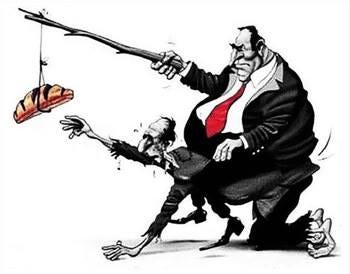
Once upon a time, life was quite
more calm. The farmer worked the land, gave
much to the Lord, but some of his own produce is his
only the rest for life. Then it happened – big
the change of expropriation in the sixteenth century and
The farmer had no more land. Changed to comrade
The worker was drawn into the struggle for satisfaction
of their living needs, and stable property was
converted into liquid wealth – capital. Instead
in order to possess a stable world of permanent objects, they are
people found themselves in an accelerated process of production and
consumerism. Labor and natural resources have changed into
“free-floating” factors of production ready
for the capitalist market. With this redesign, however, they are
century-old institutions also “liquefied”,
which provided the Farmer with security and identity for a long time.
Mr. Kapital and Comrade Delavec were not
just best friends, but they still see each other a lot
and socialize productively. They had worse and better
days, ups and downs, but they depended on each other
the other, one without the other did not exist. If
Mr. Kapital wanted the job well done,
had to control Comrade Delavec himself. So
they stayed in the same cage willy-nilly and they were
forced to negotiate despite frequent arguments,
adapt and coordinate in creating tolerable
the rules of socializing together.
The period of “liquid modernity”, like today
the period is called Zygmunt in the work of the same name
Bauman, however, one partner was let out of the
cages. Heavy modernity was the era of “mutual
of engagement, fluid modernity is an epoch
disengagement, elusiveness, easy escape
and hopeless pursuits. In the ongoing modernity, those who rule
which are the most elusive, which move freely
and they never announce their movements,” he continues
Bauman interpretation.
The employment system we knew until
now, based on high standardizations in all
its dimensions: regarding the employment contract, place and
working time. It goes without saying that work is also done
performed in a certain place, at a certain time
and in organizations or companies. Borders between
work and non-work are clearly delineated, time and
spatially defined and represent a border between
unemployment and employment. Standardized
the system of full employment is starting, as
explains Ulrich Beck (Risk society: on the way
to some other modern), slowly dismantle s
flexibilization of its main dimensions: work
law, place of work, working hours. Borders
between work and non-work, they become blurred, spread flexible forms of “underemployment”.
Technology has made it possible for Mr. Kapital
can control and manage the Worker comrade
Indirectly. Internal corporate links are at
can be established electronically in most areas.
Connection between work and production processes
loosens up. Locally visible business forms,
e.g. high-rise buildings and factory halls, the steps are invisible
company organization. Work flexibility
of time, transition from full-time to various
and part-time jobs
cannot be executed income fixed and
neutral. By dividing working time, the goal of which
is a generalization of underemployment, it goes hand in hand
also redistribution of income, social security,
career opportunities, positions in the company in the direction
down, in the sense of a collective fall (average across
professional, professional and hierarchical differentiations).
The working time policy is in this sense, as
Beck further thinks, also the politics of creation
new social insecurities and inequalities. In that
system, unemployment takes various forms
underemployment practically integrated into the system
recruitment, and it is replaced by generalization
job insecurities, which are “aged” by the industrial
he did not know the social system.
Mr. Kapital thus threw off the annoying burden
control and maintenance costs, he got rid of the excess
the cover that tied him in direct contact
with Comrade Delavec, who exploits him for his own
self-reproduction and self-magnification. Theirs
mutual dependence was unilaterally broken.
Comrade Worker still depends on attendance
of Mr. Kapital, while Mr. Kapital
it can swim freely after various lures
opportunities – and the partners with whom he will go down
into them. Travels easily and quickly, with a portable
computer in one hand and mobile phone in the other hand,
which became the main source of uncertainty for everything else.
Mr. Kapital does not insist on force. He prefers to fit in
grid of possibilities as if he were paralyzed in a certain
service. He has no problem destroying what he did, if that
it takes a moment. He doesn’t care about his creations permanently
binds, especially not emotionally. Almost nothing can
stop in his parade.
Even the institutions of the modern state are losing theirs
they can no longer guarantee strength and comrade Worker
security. “The modern state is wearing out,” he says Baumann. While all factors of political
lives remain where they were, tied to their own
positions, power flows far beyond theirs
reach. “Our experience is similar to experience
of passengers on a plane who discover high in the air that
the pilot is not in the plane,” writes Zygmunt Bauman. Mr
Capital became mobile, not tied to territory,
which enables him to extort political agencies,
bound to the territory. Every government must take note
withdrew his threat to move elsewhere
your investments. Mr. Kapital’s government cannot
force him to stay, but he can entice him with creation
the best possible conditions for free enterprise, which
means that it has to adjust its political
engaging in the rules of free enterprise.
The government uses all the power at its disposal, yes
deregulates, abolishes and repeals existing laws
and regulations that hinder entrepreneurship. In practice this
means low taxes, less or no rules, above all
and a flexible labor market. There are no concrete examples
need to look far. Slovenian Minister of Finance
Andrej Bajuk otherwise defends the principle that work does not
may be taxed more than capital and yet it is
his government first gave tax relief to capital.
 RCS - Business Default
Leave a comment