
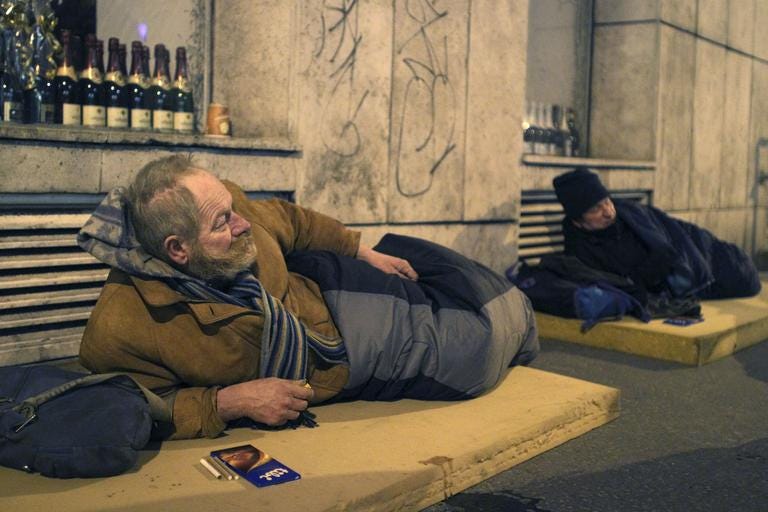
When we hear the word homeless, we picture our own
image of a poor man. Some feel sorry, some you do
they turn a blind eye to them. But many times we hear people say yes
they are lazy people who do not feel like working and that it is their own fault
position. However, this is not always true, as every homeless person carries
your story and your reasons for your position.
This article is about the causes that lead people to homelessness.
Today’s society is for many compared to society
good in the past. We have a higher standard than we used to, folks
we have our own houses, our own family, young people separate from ours
parents and we try to live on our own… However, this is only one
side of the story of modern society, because as a contrast on the other
ever-increasing hardships of socially vulnerable groups appear
people, that is, people who cannot get a job, who live from day to day
in the day, which are marked in one way or another.
In addition to these problems, there are also mental difficulties that can be
a reflection of the too fast pace of current life or a reflection of hardship,
which comes from the desire to survive.
In modern society, the social production of wealth is
systematically linked to the social production of risks. Z
it appeared with the development of industrial or class society
the question of how to distribute the produced wealth unequally and
at the same time legitimate. This definitely leads to a risk society,
because it can happen to any one of us to land in the middle
those to whom wealth will not be equally distributed. Because
it can also be called a society of inequality.
In the 1980s and 1990s, many cities
in the most developed countries faced with homelessness and growing
the population of people in housing distress. When aggravated
the supply of affordable housing has also grown
the number of households in short-term emergency accommodation
arrangements.
A study in Council of Europe member states showed that
the following are the most exposed to housing risks
groups: low-income families, unemployed, people,
addicted to alcohol and drugs, poorly educated, single parent
households, large families, ethnic minorities, especially Roma,
people with psychosocial disabilities, youth who stayed behind
without parental support.
Homelessness as a response to social vulnerability and as
the biggest form of housing risk is ever increasing.
However, modern homeless people do not fit in developed societies
more classic images of a bum, an acute alcoholic or
of traditional klateža, which is most often attributed to them.
New homeless people have different characteristics. He is among them
more and more young people, women with children and psychiatric users
institutions. Organizations that work with the European Union
homeless people, note that homelessness is in most cases
a transitional period that often occurs at breakthroughs
moments of the life cycle such as the departure of parents or divorce.
There are several definitions of homelessness, but they all stem from the fact that
homeless are those who do not have permanent accommodation.
The homeless are those who live and sleep on the roads, there are also those who
who live in shacks, trailers and similar inappropriate
buildings, as well as those that have a very low standard and
they don’t have their own apartments.
The homeless population has certain characteristics that
we can briefly summarize:
• For most, homelessness is only a temporary condition.
• Increasingly, homelessness occurs in the most vulnerable
moments of life – during the transition to adulthood and independence,
in case of divorces, etc.
• More than half of the homeless are aged between 20 and 39.
• The vast majority of them have been employed at some point in their lives, mostly
in casual and non-permanent jobs.
• Most have an education that does not go beyond elementary school.
• Most of them belong to the dominant ethnic group in
the country.
• Previously, the majority of homeless people were men, in the 1990s
years, 40% of them are women.
The vast majority of men in this population are single; at
for men, homelessness is often associated with incapacity
establishing lasting interpersonal relationships, and for women with
withdrawal from domestic violence.
Housing crises and homelessness are the result of the web
circumstances, namely on the one hand individual decisions and
characteristics of affected individuals, and social characteristics on the other
circumstances that determine the range of his options. A case of
the interweaving of the micro level, which concerns the individual, and the macro level
level that concerns the social structures to which the individual
he cannot influence himself.
Listed below are several factors that lead to
housing and homelessness issues:
• Growing number of households
In today’s society, population growth is slower
or even stagnates, while the number of households is growing a lot. This one
change means greater need and greater demand for
residential units. Due to the increasing number of people who
they cannot find suitable housing, they become pathological
housing situations that often lead to forced
housing relations. This, in turn, increases the volume of housing
problems.
• New poverty and growing unemployment
Globalization processes and structural changes in the market
labor force caused a sharp increase in the number of unemployed
and the resulting increased pressure on social housing.
Most developed economies produce people whose
potential productivity is so low that they privately
the economy does not want to hire at a price that comes close
normal living standards. Long-term unemployment, which
often accompanied by despair over employment, and permanent dependence on
support increases the number of poor. This is also active housing
issues that can lead to homelessness.
• Housing privatization and unaffordability
apartments
Privatization of housing has disadvantaged low-income groups
incomes to access public rental housing at a moderate rate
values. Also, apartment prices are often too high for
people with lower incomes and unemployed, which again leads to
housing issue.
Despite privatization, the state takes care of people to some extent
housing rights. It leaves less room for the vulnerable population
dependence on the interests of the private sector. With private
the sector participates and it with incentives and reasoning
of contractual partnership relationships is directed towards respect
set standards. But sometimes to housing services
of the private sector sets price, quality and legal
standards.
• Mental problems;
The reason for homelessness can also be the helplessness of the individual
deal with problems. Some succeed through individual
or group solutions, but not others and it can be one of
also results in homelessness. However, in my opinion
homelessness is by no means only a negative consequence
individual problems, but it can also be positive,
namely when among other homeless people and in a new way
the individual finds his own life again and lives
a new, completely different life.
• Youth homelessness
Recently, more and more young people are becoming homeless.
The age limit of the homeless population is being lowered. Get young
they decide on this way out of poverty or lack, or because
inability to control one’s own life. Most of the time it works
for young homeless people, for those who abuse alcohol or drugs,
who have dropped out of the education system, who live in institutions,
whose parents or guardians have died, who do not get along with their parents,
unemployed, refugees, etc.
• Problems in the family
Family issues are also a very important factor
at risk of homelessness. In adults, marital quarrels and
divorce is a common reason for deciding to live in homelessness,
in young people, quarrels in the family are the cause of brittleness
identity, so the young person organizes his life in such a way that
this becomes consistent with his inner feelings which
was experienced in the family, which conditions the emergence of various forms
street life.
• Educational structure
A lower level of education can be a risk factor as well
between the young and the elderly, which can also lead to
homelessness.
• Abuse of drugs, cigarettes and alcohol
Drugs, alcohol and cigarettes can quickly lead a person to
a path of addiction whose main goal is to get to them again and again. A
does not go without money, so in some cases the individual
first he borrows from friends, steals money or sells things,
but when he can’t go any further, he goes to the street and begs.
• Social rejection
• Running away from home and from various institutions
• Fatalism – devotion to fate
• Immigration and inability to get housing
• Desire for a different life
These are just some of the possible causes that lead to housing
and homeless issues. External circumstances could
described as a “stage”, where it is from the individual, his
abilities and resources, whether he will step on it or not
will be able to avoid it with his or someone else’s help.
Based on knowledge about today’s risk society and according to
a series of factors that influence the emergence of homelessness, so
we really can no longer say that all homeless people are also lazy.
Some may be true, but the rest may be a series of others
factors that led to this situation.
 RCS - Business Default
Leave a comment